Back to integrations
Databricks and Radar integration
Save yourself the work of writing custom integrations for Databricks and Radar and use n8n instead. Build adaptable and scalable Data & Storage, workflows that work with your technology stack. All within a building experience you will love.






How to connect Databricks and Radar
Create a new workflow and add the first step
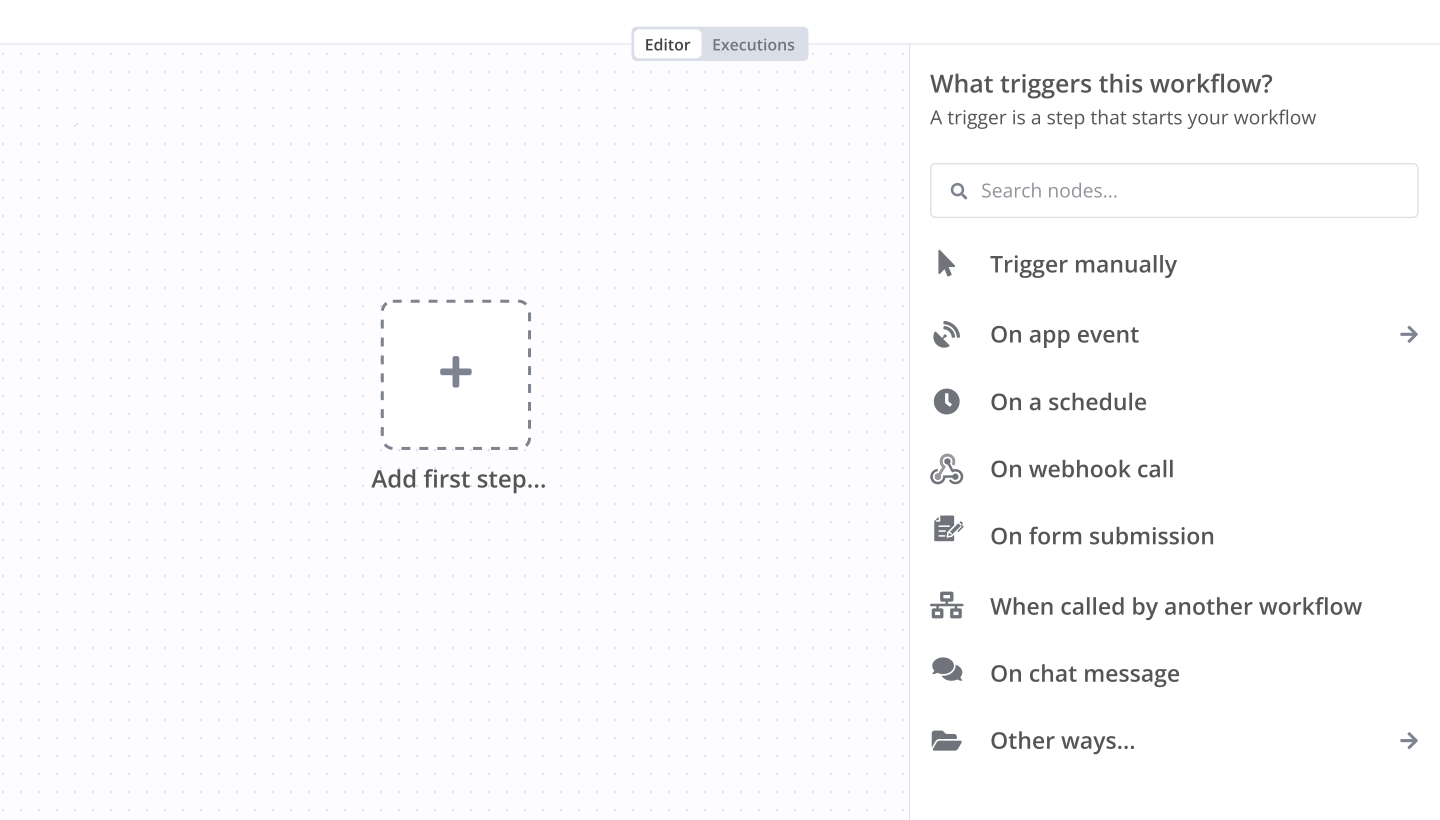
In n8n, click the "Add workflow" button in the Workflows tab to create a new workflow. Add the starting point – a trigger on when your workflow should run: an app event, a schedule, a webhook call, another workflow, an AI chat, or a manual trigger. Sometimes, the HTTP Request node might already serve as your starting point.
Build your own Databricks and Radar integration
Create custom Databricks and Radar workflows by choosing triggers and actions. Nodes come with global operations and settings, as well as app-specific parameters that can be configured. You can also use the HTTP Request node to query data from any app or service with a REST API.
Databricks supported actions
Execute Query
Execute a SQL query and wait for results
Create Directory
Create a directory in volume
Delete Directory
Delete a directory in volume
Delete File
Delete a file from a volume
Download File
Download file content from a volume
Get File Metadata
Get file metadata from a volume
List Directory
List directory contents in volume
Upload File
Upload a file (up to 5 GiB) to Databricks volumes
Create Conversation Message
Create a new conversation message
Execute Message SQL Query
Execute a SQL query from a message attachment
Get Conversation Message
Get a conversation message by ID
Get Genie Space
Get details of a Genie space
Get Query Results
Get results of a SQL query execution
Start Conversation
Start a new conversation
Query Endpoint
Query a serving endpoint. The input format is automatically detected from the endpoint schema.
Create Catalog
Create a new catalog
Create Function
Create a new function
Create Table
Register a new table
Create Volume
Create a new volume
Delete Catalog
Delete a catalog
Delete Function
Delete a function
Delete Table
Delete a table
Delete Volume
Delete a volume
Get Catalog
Get catalog information
Get Function
Get function information
Get Table
Get table information
Get Volume
Get volume information
List Catalogs
List all catalogs
List Functions
List functions in schema
List Tables
List tables in schema
List Volumes
List volumes in schema
Update Catalog
Update catalog information
Create Index
Create a new vector search index
Get Index
Get details of a vector search index
List Indexes
List all vector search indexes
Query Index
Query a vector search index with text or vectors
Supported API Endpoints for Radar
POST
Track location
Tracks a location update and returns the user and the events generated.
/v1/track
GET
Get context
Gets context for a location based on coordinates.
/v1/context
GET
Forward geocode address
Geocodes an address, converting address to coordinates.
/v1/geocode/forward
GET
Reverse geocode coordinates
Reverse geocodes a location, converting coordinates to address.
/v1/geocode/reverse
GET
Get geocode by IP address
Geocodes the requester's IP, converting IP address to city, state, and country.
/v1/geocode/ip
GET
Autocomplete addresses
Autocompletes partial addresses and place names, sorted by relevance and proximity.
/v1/search/autocomplete
GET
Search users
Searches for users near a location, sorted by distance.
/v1/search/users
GET
Search geofences
Searches for geofences near a location, sorted by distance.
/v1/search/geofences
GET
Search places
Searches for places near a location, sorted by distance.
/v1/search/places
GET
Validate address
Validates the input address.
/v1/addresses/validate
GET
Calculate distance
Calculates the travel distance and duration between an origin and a destination.
/v1/route/distance
GET
Calculate distance matrix
Calculates the travel distances and durations between multiple origins and destinations for up to 625 routes.
/v1/route/matrix
POST
Match route
Snaps points collected along a route to roads that were most likely traveled on.
/v1/route/match
GET
Get directions
Calculates the most efficient route between two or more locations to visit in order.
/v1/route/directions
GET
Optimize route
Calculates the optimal ordering and route to visit a list of locations.
/v1/route/optimize
POST
Create user
This endpoint allows the creation of a new user in the Radar system.
/api/v1/users/create
GET
List users
This endpoint retrieves a list of users tracked in your project.
/api/v1/users/list
PUT
Update user
This endpoint updates the information of an existing user.
/api/v1/users/update
DELETE
Delete user
This endpoint removes a user from the Radar system.
/api/v1/users/delete
GET
List users
Lists users sorted by updatedAt.
/v1/users
GET
Get user
Gets a user referenced by Radar _id, userId, or deviceId.
/v1/users/:id
DELETE
Delete user
Deletes a user which can be referenced by Radar _id, userId, or deviceId.
/v1/users/:id
To set up Radar integration, add the HTTP Request node to your workflow canvas and authenticate it using a generic authentication method. The HTTP Request node makes custom API calls to Radar to query the data you need using the API endpoint URLs you provide.
See the example hereThese API endpoints were generated using n8n
n8n AI workflow transforms web scraping into an intelligent, AI-powered knowledge extraction system that uses vector embeddings to semantically analyze, chunk, store, and retrieve the most relevant API documentation from web pages. Remember to check the Radar official documentation to get a full list of all API endpoints and verify the scraped ones!
Databricks and Radar integration details
Databricks
Related categories
FAQs
FAQ
Can Databricks connect with Radar?
Can I use Databricks’s API with n8n?
Can I use Radar’s API with n8n?
Is n8n secure for integrating Databricks and Radar?
How to get started with Databricks and Radar integration in n8n.io?
The world's most popular workflow automation platform for technical teams including





Why use n8n to integrate Databricks with Radar
Build complex workflows, really fast